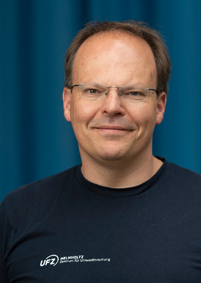
Prof. Dr. Patrick Fink
Curriculum vitae
| since 12.2024 | Group Leader General Ecology, Institute for Zoology, University of Cologne |
| 11.2018 - 11.2024 | Group leader Experimental Aquatic Ecology, Helmholtz Centre for Environmental Research (UFZ) |
| 10.2017 – 10.2018 | Group leader, Institute for Zoology, University of Cologne |
| 04.2015 – 09.2017 | Substitute for a Chair in Zoology and provisional head of the Institute for Cell Biology, University of Duesseldorf |
| 01.2015 | Habilitation (venia legendi) in Zoology, Univ. of Cologne |
| 10.2006 – 03.2015 | Scientific Assistant (junior group leader), Zoological Institute, Workgroup Aquatic Chemical Ecology, University of Cologne |
| 07.2005 – 09.2006 | Postdoctoral scientist, Department Physiological Ecology, Max-Planck-Institute for Limnology, Plön |
| 11.2001 – 06.2005 | PhD, University of Konstanz; dissertation entitled “Food quality and food choice in freshwater gastropods: Field and laboratory investigations on a key component of littoral food webs “, rated summa cum laude (excellent), Oct 21st, 2005 |
| 01.2001 – 10.2001 | Diploma thesis entitled “Colony-induction in Scenedesmus by Daphnia”; rated excellent |
| 10.1998 – 12.2000 | Advanced Studies in Biology (Diploma), University of Konstanz |
| 10.1996 – 09.1998 | Basic studies in Biology (Vordiplom), Univ. of Tuebingen |
Research interests
Research on various aspects of the ecology of aquatic organisms in response to environmental change and heterogeneity. In particular, we are interested in adaptations of these organisms on the levels of behaviour, physiology, phenotypic plasticity and evolution. We address our research question with a broad spectrum of methods ranging from molecular biology, analytical chemistry, stable isotope analysis, physiology and behaviour. We aim to relate the organisms and their adaptive response to properties of the whole ecosystem such as biodiversity, food web structure, trophic transfer or matter and energy to gain a better understanding of ecosystems' structure and functions.
Member of scientific societies
• Association for the Sciences of Limnology and Oceanography (ASLO)
• International Society for Limnology (SIL)
• German Zoological Society (DZG)
• German Limnological Society (DGL)